


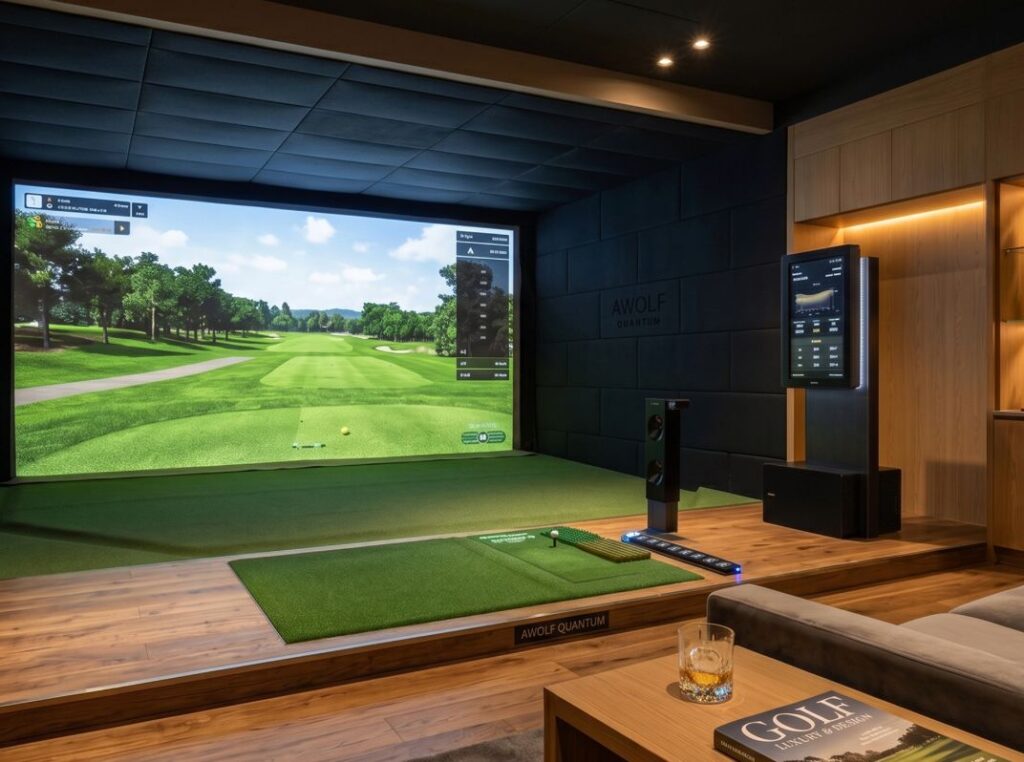
To install a golf simulator, you usually need a room between 3 and 4.6 meters wide, 4.6 and 6 meters deep, and 2.7 and 3.2 meters of clear height. These are guideline ranges, not a standard: exact measurements depend on the player, the tracking system, the screen, the projector, and whether right- and left-handed players will be using it. As a comfortable reference for a full installation on a flat surface, start with about 4 × 5.5 × 3 meters. If the system includes a platform, allow for more depth—up to 6.5 m. Before buying or renovating, check that the driver can complete its full swing without coming close to the ceiling, walls, or technical elements.
There is one factor that changes the equation from the start: if the simulator includes a platform that simulates real play (like Awolf Quantum), the minimum height rises to 3 meters. The extra 30 cm is the space occupied by the platform under the hitting area.
Installation type | Width | Depth | Height |
|---|---|---|---|
Compact, single-sided (no platform) | 3–3.4 m | 4.6–5 m | 2.7–2.9 m |
Comfortable residential (no platform) | 3.7–4.6 m | 5.2–5.5 m | 2.75–3.1 m |
Professional or right- and left-handed (no platform) | 4.5–5 m | 5.5–6.5 m | 3–3.2 m |
With dynamic platform that recreates the game (Awolf Quantum) | 4.2–4.7 m | 6.5 m | 3–3.2 m |
The ranges in the table are for planning purposes. Manufacturer specifications and technical validation of the installation always take priority.
The space required changes depending on the intended use, but so do the technology, accessories, and features you activate. Before renovating the room, answer a more important question: What are you going to use the simulator for?
A weekend session, playing 9 or 18 holes with the kids, inviting friends to try Pebble Beach. Here, comfort, visual appeal, and an immediate experience are key: just plug and play.
Just any simulator won’t do here. You need precise measurement, objective swing feedback, and the ability to repeat the same shot a hundred times with data.
Perhaps the most underestimated use. Great simulators connect to global player networks where weekly competitions with prizes are held.
The only case where profitability is king. Here, the simulator has to rotate: every empty hour is lost money. And there is a silent enemy—time per round. If 18 holes take 3 hours, your bay is billing a third of what’s possible.
This is most common in well-planned installations: a club that wants to train its members during the week and bill tournaments on Saturday; an individual who plays with friends but also trains; a hotel that offers an experience to guests and an internal league to staff.
Because it brings together in a single piece of equipment the five differentiators that each use needs:
Golden rule: the more versatile the intended use, the more weight measurement precision, the platform, and the gaming ecosystem carry. If you’re going to use it for more than one thing, the decision is no longer just about space.
Not all golf simulators need the same space. A launch monitor placed next to the ball requires a different layout than a radar behind the player or a ceiling sensor.
Dimensions also change according to: the player’s height and swing type; the length of the club used; the ball position; the location of the launch monitor; the screen size and format; the distance needed for the projector; the safety space behind the screen; the presence of right- and left-handed players; and whether it’s for domestic, educational, or commercial use.
Learn more with our golf simulator guide.
Most installations need between 2.7 and 3.2 meters of clear height. A height of about 3 meters is usually a good initial reference, but it doesn’t guarantee on its own that all players will be able to use the simulator.
Measure from the final surface the player will stand on to the lowest obstacle on the ceiling. Consider beams, false ceilings, lamps, AC ducts, sprinklers and detectors, projectors, garage door motors and tracks, platforms, or mats that raise the hitting area.
The driver determines the necessary height because it is the longest club in the bag. A tall player or one with a vertical swing might hit the ceiling in a room that is sufficient for someone else.
Before confirming the space, take several full swings with the driver, without a ball and at a controlled speed. If the club passes close to the ceiling or the player shortens the movement for fear of hitting it, there isn’t enough usable height.
Systems that hit on a flat surface usually ask for 2.7–2.8 m. Awolf Quantum asks for a minimum of 3 meters for a specific reason: under the hitting area there is a 15X Swing Plate platform that reproduces up to 19,000 real-world lies—uphill, downhill, sidehill, and ball above or below feet. It’s the same sloped terrain as the course.
Those 20–30 cm are the physical space occupied by the platform. With 2.8 m you can install a system on a flat surface. From 3 m up, the dynamic platform option also opens up. It’s a decision of height and purpose—it’s worth checking the exact centimeters before ruling anything out.
Awolf Quantum reference: 3 m minimum clear height (to be able to integrate the platform), 3.2 m recommended for tall players or vertical swings.
The usual width is between 3 and 4.6 meters, although a professional installation or one prepared for right- and left-handed players may need close to 5 meters.
A narrow setup forces the ball to be offset from the center of the screen. It can work for a single direction of play, but makes it difficult for right- and left-handed players to use the same position.
As a reference: between 3 and 3.4 meters is enough for a compact installation and single-sided play; between 3.7 and 4.2 meters for comfort in a home installation; between 4.5 and 5 meters for use by right- and left-handed players + a wider screen.
The nominal width of the room doesn’t always match the available space. Subtract the thickness of side protections, curtains, acoustic panels, columns, and any fixed furniture.
Awolf Quantum reference: 4.2 m wide for one side of play, 4.7 m for right- and left-handed players.
A golf simulator room usually needs between 4.6 and 6 meters of depth. Some professional systems or setups with a circulation area may require approximately 6.5 meters.
The depth is divided between: separation between the impact screen and the wall; distance from the screen to the ball; space occupied by the player; backswing path; launch monitor location; clear area behind the player; space for the projector and auxiliary equipment.
Awolf Quantum reference: 6.5 m total depth. We combine a high-speed camera + proprietary sensors: you don’t need a radar behind the player or a ceiling sensor.
A compact simulator can start from about 14–17 m²; a comfortable home installation occupies between 20 and 25 m².
Room measurements | Surface area |
|---|---|
3 × 4.6 m | 13.8 m² |
3.5 × 5 m | 17.5 m² |
4 × 5.5 m | 22 m² |
4.6 × 5.5 m | 25.3 m² |
4.7 × 6.5 m | 30.6 m² |
Square meters should not be used as the only criterion. A 25 m² room with a 2.5 m height is unfeasible, while a smaller, well-proportioned one can accommodate a compact setup.
A garage can house a simulator if it offers enough height, width, and depth. The main difficulty is usually the door tracks and motor, which reduce the clear height right over the swing area.
You should also check: water ingress and humidity, extreme temperatures, exterior lighting, ventilation, electrical availability, internet connection, floor leveling, and compatibility with vehicle use.
Measure the garage with the door open and closed. If the mechanism invades the path of the club, change the layout or adapt the opening system.
A basement can be a good location due to its insulation and light control, but it must have sufficient height and ventilation. Many basements meet the required surface area but fail due to a ceiling that is too low. Also check humidity, access, emergency exits, and the clearance available to bring in the screen, structure, and technical components.
Proper dimensions alone do not guarantee a functional installation. The project must also consider flooring, electricity, connectivity, sound, and temperature.
Error | Consequence | How to avoid it |
|---|---|---|
Measuring only square meters | Room too low or narrow | Measure all three dimensions separately |
Ignoring beams and lamps | Risk of hitting the ceiling | Use the lowest point as a reference |
Not testing with the driver | The widest swing might not fit | Do controlled tests before buying |
Forgetting left-handed players | Incompatible hitting position | Plan a centered and wider area |
Not subtracting protections | Usable space is reduced after work | Include their thickness in the plan |
Choosing the projector first | The image might not fit the screen | Design screen, distance, and optics together |
Ignoring sensor technology | The monitor measures incorrectly | Respect the manufacturer’s distances |
Buying before validating | Changing equipment or renovating | Request a prior technical study |
Installing without defining use | Oversizing or falling short | Decide first if it’s for enjoyment, training, tournaments, or business |
Ruling out by height without distinguishing platform | Ruling out without knowing about dynamic swing platforms | If you have 3 m, consider a platform. If you have 2.7 m, assume a flat surface |
Once general ranges are established, each model must be evaluated with its own specifications. The Awolf Quantum simulator needs:
Quantum is a complete platform. It includes:
And a layer that doesn’t take up meters
Quantum doesn’t end in the room. Every shot you hit inside goes into the same history as the ones you hit on the course—all within the same 100% golf ecosystem, the Awolf app. The simulator is the physical entry point to an ecosystem that keeps working when you leave the room. And that doesn’t ask for a single extra centimeter of height.
That’s why a Quantum room review includes flooring, electrical installation, and connectivity, in addition to the three dimensions.
Quantum is designed for golf clubs, indoor centers, hotels & resorts, and private homes.
Tell us your room measurements and intended use (enjoyment, training, tournaments, business, or all at once) and a member of the Awolf team will tell you within 48 hours if Quantum fits—and what specific configuration you need.
Request your free technical study →
It depends on the type of simulator. With a flat surface and players of average height, 2.7 m can work. If the simulator includes a dynamic swing platform (like Awolf Quantum, which reproduces up to 19,000 lies), the minimum height rises to 3 m. Before deciding, take full swings with the driver and check the manufacturer’s exact specifications.
Three meters can work in a compact installation configured for a single side of play. The player may have to hit from an offset position. If right- and left-handed players will use the simulator, it’s usually preferable to have 4.5 m or more.
It depends on the screen, the structure, and the tracking system. Some setups use around 2.5–3 m between the ball and the screen, but there is no single figure valid for all simulators. An incorrect distance can affect safety, measurement, and image.
There must be room to complete the backswing and, if the sensor uses radar, to install the device at the indicated distance. The total depth is usually between 4.6 and 6 m.
Yes, as long as the full swing, screen, and monitor are compatible with its dimensions. It may require a narrow screen, hitting from an offset position, or choosing a side-mounted sensor.
Yes. The technical measurements of the bay do not include a safe area for waiting, sitting, or moving around. Separate the social area from the path of the club.