


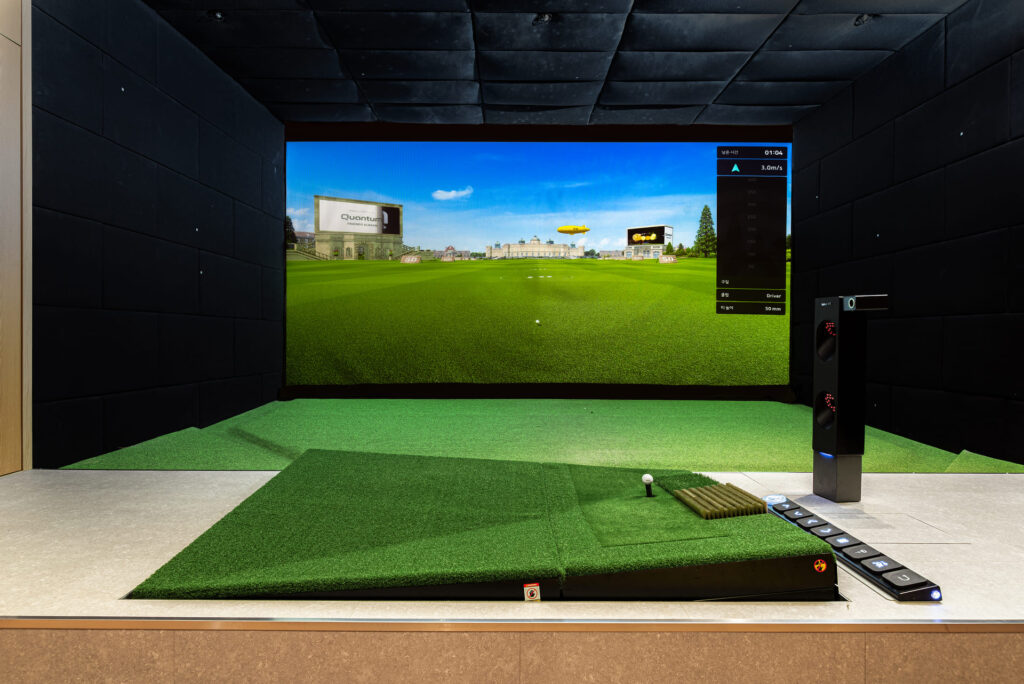
For years, golf simulators were seen as an occasional alternative: a way to train when you couldn’t get out on the course.
That idea is now behind us.
Indoor golf has become a key tool for improving performance, analyzing your game with precision, and training real-life situations that used to be possible only on the course.
In this guide, we explain what a golf simulator is, how it works, what types are available, and why indoor golf is changing the way we train and compete.
A golf simulator is a technology system that lets you hit real balls while it analyzes impact and recreates ball flight in a virtual environment that simulates a golf course.
A simulator combines three main elements:
When you hit the ball, the system measures parameters such as:
With this data, the software recreates the shot on a virtual course, letting you analyze every detail of your swing.
Not all simulators offer the same experience. Today, there are three main categories:
They’re the most advanced and accurate. They’re used in academies, high-performance centers, and professional club fitting.
Key features:
Examples: TrackMan, Foresight Sports, and next-generation solutions like Awolf Quantum.
Designed for home use or frequent training.
Key features:
Examples:
They’re compact devices that let you train anywhere.
Key features:
The price of a golf simulator varies depending on the technology and level of accuracy.
Indoor training offers benefits the course can’t always replicate.
Every shot generates objective data. You can spot mistakes and track progress accurately.
You can work on the same distance or situation as many times as you need.
You’re not dependent on weather, light, or course availability.
The big leap in golf simulators was access to data.
For the first time, any player could understand what was happening in their swing.
But data alone doesn’t guarantee improvement.
On a real course:
Traditional indoor setups didn’t reproduce these variables.
Today’s evolution in indoor golf isn’t just about measuring better, but about simulating reality better.
With solutions like Awolf Quantum, the simulator includes a dynamic platform with 15 axes of movement, capable of recreating:
This forces the player to adapt on every shot.
You’re no longer training technique alone.
You’re training adaptability, decision-making, and realistic execution.
A golf simulator is used to:
When the system integrates data + simulation + physical setup, training gets much closer to the real course.
No.
The course is still the real competitive environment.
But a simulator lets you precisely prepare what you’ll later execute out on the course.
Today’s approach to golf is phygital:
This cycle speeds up improvement.
The real change isn’t only in the hardware.
It’s in the connection between training, competition, and community.
With the Awolf ecosystem:
The simulator stops being a standalone tool.
It becomes part of a complete experience.
The golf simulator has gone from an occasional solution to a strategic tool.
First, it democratized access to data.
Now it’s transforming the way we train, adding real context, variability, and continuous analysis.
The change isn’t only in the technology.
It’s in how you train.
Yes. All simulators are designed to use your usual clubs, so you can train with real feel.
It depends on the system, but generally it’s recommended:
Professional systems do. Basic models offer approximate simulations.
Between 45 minutes and 1 hour 15 minutes, depending on the number of players.
Yes, but with limitations. It’s useful for mechanics and control, but it doesn’t fully replace on-course practice.